
Using a Phone App To Diagnose Epilepsy - from Thousands of Miles Away - Dr. Victor Patterson, UK
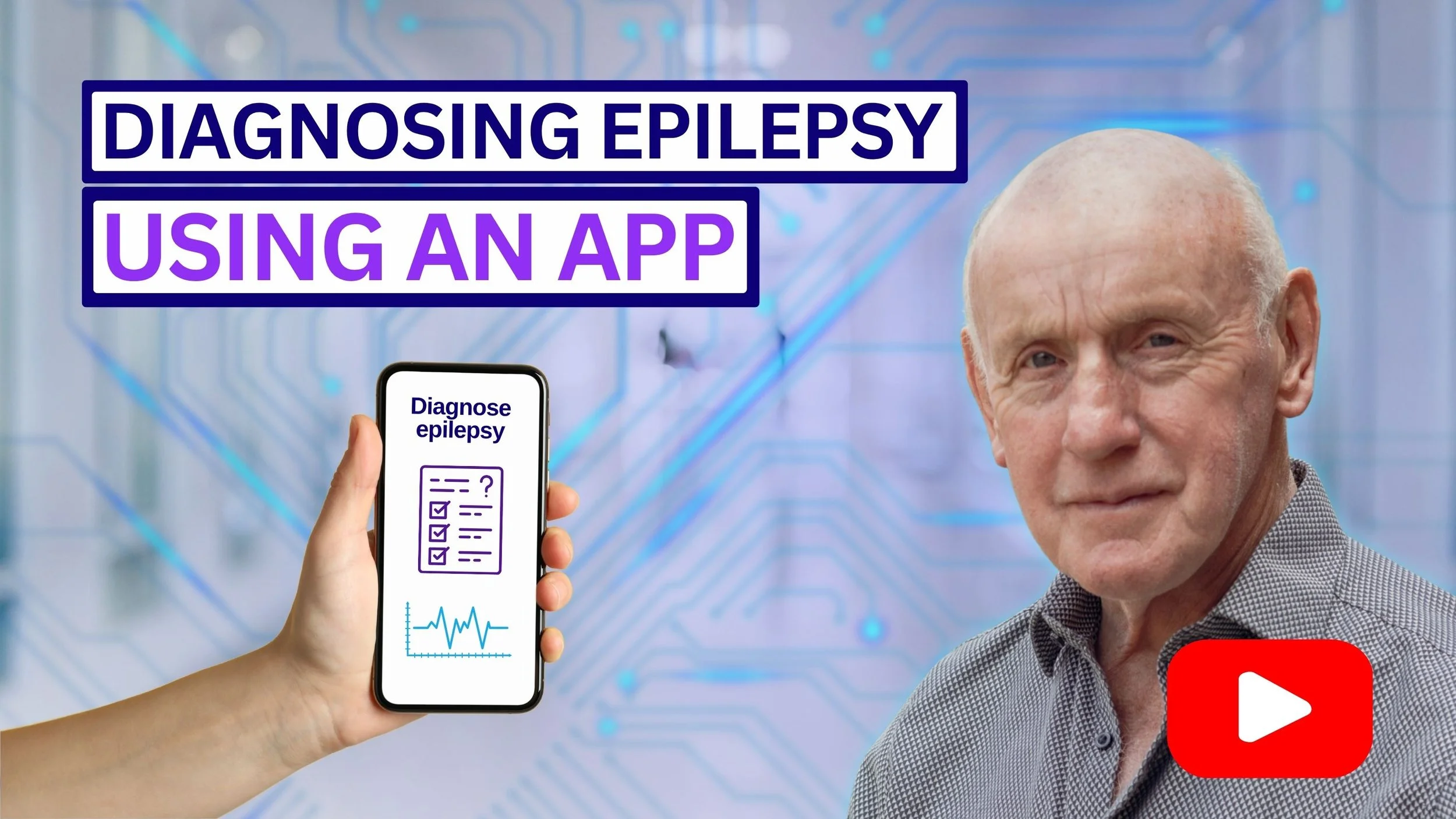
How can we improve access to epilepsy diagnosis around the world? Today neurologist Dr. Victor Patterson tells us how telemedicine, apps, AI, and machine learning can bring epilepsy expertise to people wherever they live - and why relatively simple technology could make a huge difference to millions of lives. Watch/listen/read here 👇!
Episode Highlights
telemedicine and apps can lead to accurate epilepsy diagnoses from thousands of miles away
neither people with an epilepsy nor neurologists should be scared of AI but instead embrace it
epilepsy diagnosis is possible without an EEG
About Jonathan
Dr. Victor Patterson has been a neurologist for over 50 years but for the last 12 has been working with overseas colleagues on a practical solution to reduce the epilepsy treatment gap – this is where people with epilepsy in poorer countries aren’t on any treatment for what is an eminently treatable disease. He has done this by developing smartphone applications which enable less-experienced doctors to diagnose and manage epilepsy. Together with colleagues from Nepal, India, Sudan, Pakistan, Italy, Bolivia, the Democratic Republic of Congo, and the UK, he has showed that these apps work in a series of publications.
Full profile: Victor-Patterson
Topics mentioned
telemedicine
LMICs
global health
-
Feasibility, Safety and Preliminary Effectiveness of an Epilepsy Treatment Smartphone Application in Rural Primary Care: A Two-Arm Prospective Observational Study from India - Epilepsy Research, Sep 2026
Divya Ganjoo, Hemant Kumar Tiwari, Mayank Sharma, Naina Bharadwaj, Sanskriti Yadav, Sheetal Mishra, Naveen Shukla, Shelly Gandhi, Sumi Jain, Rohit Bhatia, Mamta Bhushan Singh, Victor Patterson
DOI: 10.1016/j.eplepsyres.2026.107922Diagnostic sensitivities of an epilepsy management smartphone application and remotely-reported EEG in newly-presenting epilepsy in the Democratic Republic of Congo - Epilepsy & Behavior - Jun 2025
Prince Kazadia, Steve Coatesb, Najib Kissanic, Victor Patterson
DOI: 10.1016/j.yebeh.2025.110521A web-based telemedicine system for low-resource settings 13 years on: insights from referrers and specialists - School of Medicine, Dentistry and Biomedical Sciences, May 2013
Victor Patterson & Richard Wootton
DOI: https://doi.org/10.3402/gha.v6i0.21465Introduction to the practice of telemedicine - J Telemed Telecare, Jan 2005
John Craig & Victor Patterson
PMID: 15829036, DOI: 10.1177/1357633X0501100102 -
Trailer
00:00 Victor Patterson
“Just to talk about the questions on the app - I know some people say “Well, can you ask these questions in India and Nepal and Bolivia and Sudan?”. Well the well the answer is: you can! And if you look at videos of people all over the world having convulsive epileptic seizures, they're all exactly the same! You know, people… epilepsy is exactly the same. It looks exactly the same in all these countries! So, you can say “Do you go stiff?” and you translate that into the local language “Do you go stiff?” - yes or no? “Do you shake?” Yes or no? “Does your head turn to one side?” Yes or no? So, that's why it transfers very easily.”
Intro
00:41 Torie Robinson
Millions of people around the world with an epilepsy still don’t have access to a diagnosis - let alone the treatment that they need. But what if part of the solution could be surprisingly simple? Well, today I’m joined by neurologist Dr. Victor Patterson, who’s spent decades using telemedicine and technology to bring epilepsy expertise to places where specialists simply are not available. We are talking apps, machine learning - and how relatively simple ideas can help more people get an accurate diagnosis - wherever they live!
01:13 Torie Robinson
Hello, Victor. Welcome to the podcast. Could you tell us just a quick something about yourself and what you do, please?
Meet Victor
01:19 Victor Patterson
Well Torie, thanks very much for inviting me onto your podcast. I've been a neurologist for 50 years or so, and I retired from my work in the NHS a while ago, and I was involved in some projects overseas - in specifically in Nepal. And when I was in Nepal I it dawned on me that epilepsy was a major problem there. Because most people weren't on treatment. And since epilepsy is really one of the most treatable neurological diseases, I thought it was probably worth doing a bit more about that while I was in Nepal. So, I got interested in that when I was there.
What is telemedicine and how did it start?
02:00 Torie Robinson
I know your thing is telemedicine and you're… you brought telemedicine to us as a species, I believe before COVID. Lots of people know about it now - but actually what for people who aren't familiar, what is telemedicine?
02:13 Victor Patterson
Telemedicine is just medicine when the doctor and the patient aren't in the same place. Okay? You can be in in London and I can be in Belfast and I can give you medical advice by whatever means; by a telephone call, by a video call like this, by an email; any way I can give you medical advice: that's telemedicine. That's all it is. There's a number of different ways of doing it. And I got interested in it as a as a way of dealing with another health inequality, which is that I thought that people with acute neurological presentations in rural hospitals were not getting the same deal as people in urban hospitals. The people in urban hospitals were seeing a neurologist who would come and visit them; the people in the rural hospitals weren't. And I thought “Well, we should try and investigate if we can improve that.”. And it so happened that in the hospital I was working, was Europe's only professor of telemedicine: Richard Wootten. And he and I got together and we devised a system where we could do video calls to rural hospitals. And, you know, it's not like what we're doing now; there were there was no none of this stuff on the internet. You had to do it by phone lines and it was very complicated. So, it was complicated to do but on the other hand, the equipment that we used gave us fantastic pictures so that we could actually zoom the camera and have a very good view of the patient. And if there was somebody at the other end who could do a neurological examination, it was really just as good as a face to face examination, except it was a bit different. But there wasn't anything that you couldn't do that way. So, having done that, we then said “Well, can we can you do neurology by email?”. And I thought, you couldn't possibly do neurology by email, neurology is much too complicated.
04:16 Torie Robinson
Yeah…
04:16 Victor Patterson
This turned out to be not the case. We did a project in Bangladesh using email which was surprisingly successful. And then I introduced that to the GPs in the areas of Northern Ireland that I worked, and that worked very well. And it was a way of triaging a system and reducing your neurology waiting list. And that, of course, has now been developed within the NHS as advice and guidance.
04:48 Torie Robinson
And we’re doing it around the world, I think, as well now, more and more-so in high income countries as well as [in] lower income countries. And I know you've done heaps in lower income countries - can you tell us a bit about that? You mentioned Nepal but I'm I swear there's been other continents [upon which] you've shared this
Using an app to diagnose epilepsy
05:03 Victor Patterson
So just to get back to epilepsy: one of the difficulties of doing either video or telephone or email consultation is a question of scale. You can't you can't easily scale that up. So, if you're looking at a public health problem like epilepsy in poorer countries, you have to be able to have a system that you can scale up, ok.
05:27 Torie Robinson
Mm-hmm.
05:27 Victor Patterson
You can't scale up either of those. The thing that you can scale up is an app. And if you can get an app that can give you a really good specialist opinion, then inexperienced doctors throughout the world can use that app to treat people with epilepsy. So, that was kind of the sort of program that I vaguely envisaged. And we started doing that gradually. So, the first thing to do was find out whether “episodes” that people had were epileptic “episodes” or non-epileptic “episodes”.
06:04 Torie Robinson
Often confused, think, both by people with epilepsy and the people around them. And as you've implied, the clinicians who are not familiar with epilepsy may not notice either.
06:14 Victor Patterson
Yes, and unless you can get that sorted out, you can't really get an anything else sorted out. So, you have to be pretty reasonable. And of course, that isn't an a necessarily an easy thing to do face to face because, as everybody knows, the accuracy of that is not 100% and sometimes not anything like it. We developed this by asking a series of questions, right. So, a series of yes and no questions. And when I went to Nepal I did some epilepsy clinics and I had an inexperienced doctor with me and I said “Right, we're just going to ask this patient 40 questions.”. Okay, so, we asked 40 yes/no questions. And at the end of the questions I said I said to him “Has the person got epilepsy or not?” And he would say “No.”. And, I mean, you know, when he started off, he was absolutely hopeless, you know.
07:09 Torie Robinson
Hahaha!
07:10 Victor Patterson
But after we'd done 20 patients together, he was as good as me!
07:17 Torie Robinson
Okay.
07:17 Victor Patterson
And then… but you can't just ask 40 questions to anybody. So, we worked out which of these 40 questions were the best questions. And you can do…
07:26 Torie Robinson
Mm-hmm.
07:26 Victor Patterson
…that by a kind of machine learning type analysis. So, we worked… we got it down to about 11 questions and then we tested… we presented that as an app. And I have to say “we”, because I have worked with a software company called NetProphets in India, and they have built the app and they've done that for free. So, the two of us have done this kind of together without any without any, great sort of funds or any grants. So, that's why it's gone quite slowly.
07:56 Torie Robinson
And when did that come out? When was that released? And where is it available?
08:00 Victor Patterson
Oh, about 2014. The difficulty… I mean we did make some of these apps available, but unless they're part of a public health program, they're not actually likely to do any good.
08:13 Torie Robinson
Ah.
08:13 Victor Patterson
And the more complicated they get, the less keen we are to release them because you're releasing a medical device, you know, and without training.
So, just to talk about the questions on the app; I know some people say “Well, can you ask these questions in India and Nepal and Bolivia and Sudan?”. Well the well the answer is: you can! And if you look at videos of people all over the world having convulsive epileptic seizures, they're all exactly the same! You know, people… epilepsy is exactly the same. It looks exactly the same in all these countries! So, you can say “Do you go stiff?” and you translate that into the local language “Do you go stiff?” - yes or no? “Do you shake?” Yes or no? “Does your head turn to one side?” Yes or no? So, that's why it transfers very easily. You're not asking anything particularly cultural. You're just asking yes-no questions.
More generalised than focal seizures in low-middle income countries
09:13 Torie Robinson
But what about focal seizures? So, what about where there is no obvious physical manifestation of the seizure?
09:20 Victor Patterson
It's not so good at detecting that. It's pretty good, but not, but not so good at detecting it. But remember, in poorer countries, 90% of people have convulsive epilepsy. Focal epilepsy is much commoner here than it is overseas.
09:42 Torie Robinson
I didn't know this!
09:44 Victor Patterson
Well it is. And the reason for that is that epilepsy is bad. Epilepsy is generally worse over there because it's not treated, it's gone on longer…
09:54 Torie Robinson
And more likely to get head injuries and all these other different things.
09:57 Victor Patterson
More likely to kill you? Yeah, absolutely. More likely to maim you? Yes.
10:03 Torie Robinson
Yeah. And then another thing also, isn't it… like, troubles during childbirth, they're more likely to have those problems and then…
10:09 Victor Patterson
Yes. And that's why the prevalence of epilepsy in poorer countries is about twice as much as it is in richer countries.
Machine learning in epilepsy diagnoses
10:17 Torie Robinson
I like that we've mentioned machine learning. Lots of people get really nervous the moment you say that. But, we've been using machine learning for years and years now, as is obvious through the work that you've been doing. I read from your work that you've had a 91% accuracy in diagnosis of epilepsy using this. Tell us about that.
10:38 Victor Patterson
Let's take an example of the questions to diagnose something as an epileptic seizure. So, if you use those 11 questions, you're gonna be right. It it's n it's not much different from people taking a history. When experienced neurologists take a history, they kind of focus on what's important. And, you know, it just picks out the important questions. And I'm not really surprised that it's that accurate.
Inaccuracies in diagnosis - what then?
11:03 Torie Robinson
And what about the remaining 9%? What happens in those cases?
11:08 Victor Patterson
So, there's 2 ways of getting the diagnosis wrong: you get people with who don't have epilepsy who you treat with epileptic medication, okay. Now, that's not a good thing, but the other thing is that you treat people who have epilepsy… you treat them as non-epileptic episodes and that's not a good thing, that's not a good thing either. All I can say all I can say is that there's no way of dealing with this perfectly. And if you if you have face to face, you know, you ask this in the context of machine learning: nobody asks that question in the context of face-to-face medicine. They don't say, you know “The results are that 70% of people, only 70% of people have epilepsy. What happens to the other 30%?”. There's no way of being a 100% accurate with epilepsy the whole time.
12:07 Torie Robinson
At least yet. One can hope, I suppose. What do you think?
12:11 Victor Patterson
Well, you can hope, but unless you are going to do video-EEGs on everybody that has a seizure, everywhere in the world, which I think is pie in the sky.
Let’s take action!
12:26 Torie Robinson
So, the WHO says there are 50 million people with epilepsy in the world. Well, as far as I'm aware, we've all been breeding since that number came out and we're over 8 billion now. So, I would suggest it's far more that experience it. What number do you reckon it is?
12:39 Victor Patterson
I'm sure you're right, it is more. But you know, so, 50 million, 80 million. Okay, there's lots of people with epilepsy that aren't treated, so you need to do something about it. Let's do, let's do something about it, Torie. Let's not there's too much talk about untreated epilepsy and not enough action!
Diagnoses aren’t always complex
12:58 Torie Robinson
And your work with the telemedicine is a great example of how it doesn't have to cost the earth. As you said, the treatment…
13:04 Victor Patterson
Yeah.
13:04 Torie Robinson
…is another stage, but getting the diagnosis alone doesn't have to be overly complex, in many cases.
13:11 Victor Patterson
No, it's not. I mean, everybody agrees that the diagnosis of epilepsy is made from the history, okay? Everybody agrees, you know, standard medicine agrees that. There is a notion, however, amongst lots of doctors, that… there's two notions: one that epilepsy is very complicated and only epilepsy specialists can write the diagnosis, so they don't bother; and the second thing is you can't possibly make the diagnosis of epilepsy without having an EEG. And that isn't true. That's not true. So, you can do that. And epilepsy is… if people think that epilepsy is complicated, then you have to give them something to decomplicate it. And this app, hopefully, the aim of it is to decomplicate it.
14:00 Torie Robinson
Indeed. And I would just like one point, I suppose, with like, for instance, rare and complex epilepsies, that is a completely different area, isn't it? So, if we're talking about Dravet, Ring 20, you know, all that type of thing.
14:13 Victor Patterson
I think that is much too complicated for this, ok. I have no I have no answer to this for an app. All I all I can say is that the majority of people with epilepsy in poorer countries have convulsive epilepsy. And that can be treated with drugs and you expect half to two thirds of those people to go into remission with available anticonvulsants, which are not necessarily the most expensive anticonvulsants we have here, but effective anticonvulsants like carbamazepine.
AI and the future
14:54 Torie Robinson
So, Victor, what does the next decade hold for us when it comes to epilepsy and telemedicine?
14:59 Victor Patterson
I think that the future to be to fair… and it's not just epilepsy, I think AI is going to make a huge revolution to medicine, what doctors are, and what and how they practice. And I think a lot of AI algorithms can do what a lot of doctors are doing at the minute. And it I think it to be honest, I think it may well do it better.
15:25 Torie Robinson
And why shouldn't people be scared of AI in this circumstance?
15:27 Victor Patterson
I you're a patient, I don't see how you should be scared of AI because you're getting what is the best available treatment and management for you as as described in the literature. Remember, AI just takes everything that's been published and synthesises it as the best treatment. If you want a doctor who's really… wants to treat you as an individual, and… I think that's different. But I think most of the tasks can be done by AI, to be honest!
Closing thoughts and thanks
16:03 Torie Robinson
I love Victor’s optimism! The technology already exists, we know so much more than we used to, and improving epilepsy care doesn’t always require hugely expensive or complicated solutions. As Victor said, there’s been plenty of talk about untreated epilepsy and what we need now is action. And if relatively simple technology can bring epilepsy expertise to people who otherwise would not have access to it, that could make an enormous difference to lives around the world. If you enjoyed this episode, please subscribe and share it with anyone who may find it helpful or interesting. Thanks for watching - see you in the next episode!