
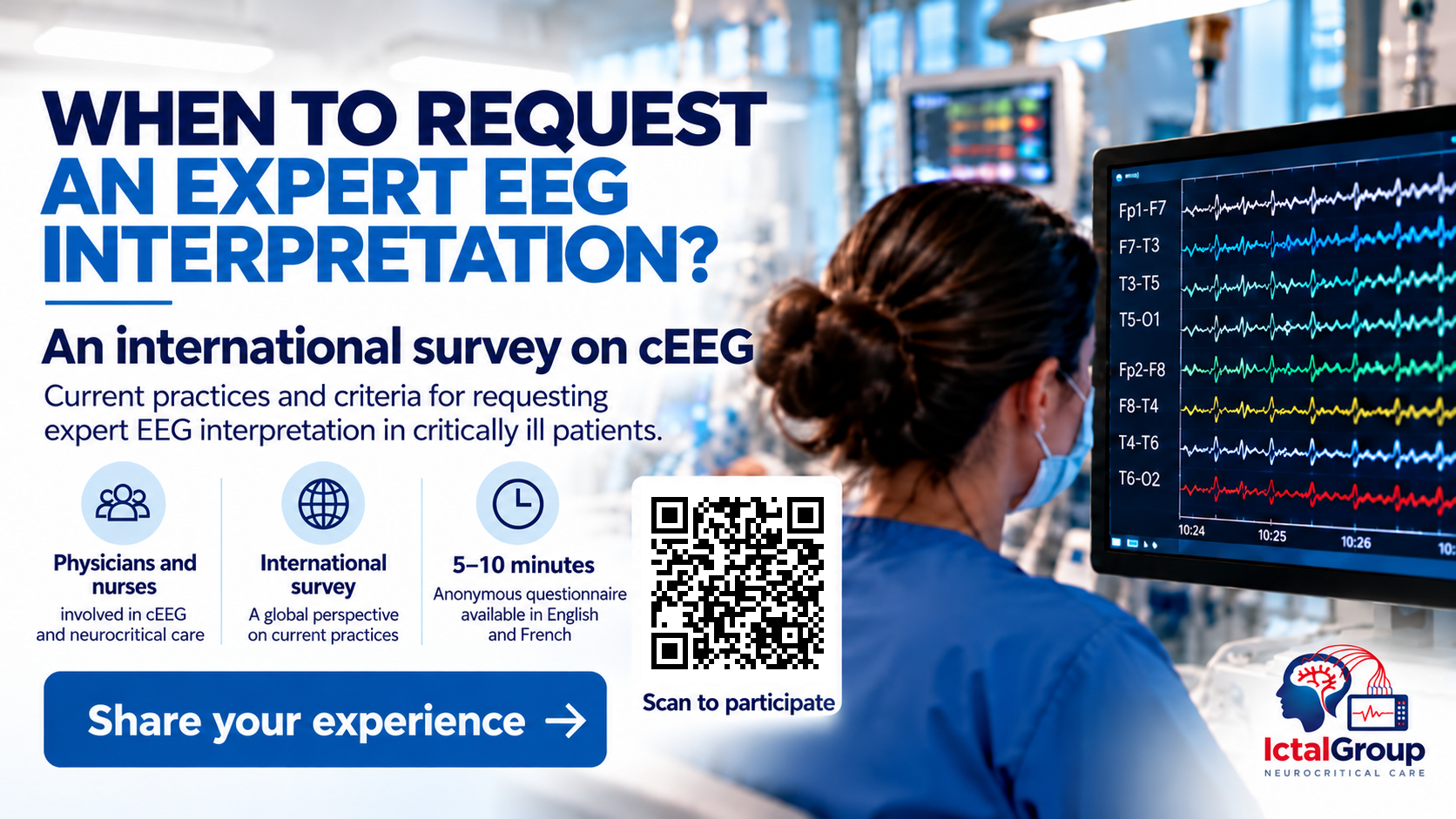
Continuous electroencephalographic monitoring (cEEG) has become an essential component of modern critical care, allowing continuous assessment of cerebral electrical activity in critically ill patients. It plays a central role in the detection of electrographic seizures, status epilepticus, monitoring of treatment response, and evaluation of patients with acute brain injury. As the use of cEEG continues to expand, the volume of EEG data requiring expert interpretation has increased substantially.
Interpretation of cEEG should not rely solely on the recognition of EEG abnormalities. Clinical decision-making requires integration of EEG findings with the patient's neurological and systemic condition, therapeutic strategy, and expected treatment-related EEG changes. Consequently, the clinical significance-and urgency-of a given cEEG event often depends on its clinical context.
Although many cEEG abnormalities are widely recognised as clinically important, there is currently no standardised international approach defining which clinically relevant cEEG events should prompt an unscheduled specialised review of the EEG recording, or how rapidly such review should be performed. As a result, clinical practice may vary considerably between clinicians and institutions.
The aim of this survey is to better characterise current international opinions regarding which cEEG events should trigger an urgent review of recording by expert in critically ill adult patients and the maximum acceptable delay before such review of recording and communication/documentation of findings.
Ultimately, we hope that these results will contribute to the development of future recommendations and implementation strategies aimed at improving timely access to expert cEEG interpretation in critically ill patients.
The survey is for health professionals.
The time taken to complete should be approximately 5-10 minutes.
Whenever appropriate, please consider the expected clinical and therapeutic context of the proposed cEEG event.
For each proposed cEEG event, you will be asked to indicate the maximum acceptable delay before it should prompt an unscheduled specialized review of the cEEG recording.
Participation is voluntary and anonymous. Individual responses will remain strictly confidential. Only aggregated and anonymized data will be analyzed and reported. Participation or non-participation will have no individual impact on the respondent's professional practice or employment status. This survey has received ethical approval from the SRLF Ethics Committee and complies with the fundamental principles of the Declaration of Helsinki (#CE-SRLF 26-052).
Thank you for contributing to this international survey.
Click HERE to take part in this survey.
-
Professor Stéphane Legriel, MD, PhD, Versailles Hospital - Versailles Saint-Quentin-en-Yvelines University, Versailles, France; IctalGroup Research Network
Professor Carolina B. Maciel, MD, MSCR, Department of Neurology University of Florida, Gainesville, USA
-
For any questions regarding this survey, please contact:
E-mail: slegriel@ght78sud.fr