
Treatment Strategies and Specialist Epilepsy Care - Prof. Bernhard Steinhoff, Diakonie Kork, Germany
Good epilepsy care isn't about pills - it's about prevention, care, prescribing the right treatment, at the right time, for the right person. It’s about understanding each individual, their specific needs, and looking beyond seizure control. Hear more from Epileptologist Prof. Bernhard Steinhoff on this week’s podcast! Watch/listen/read here 👇!
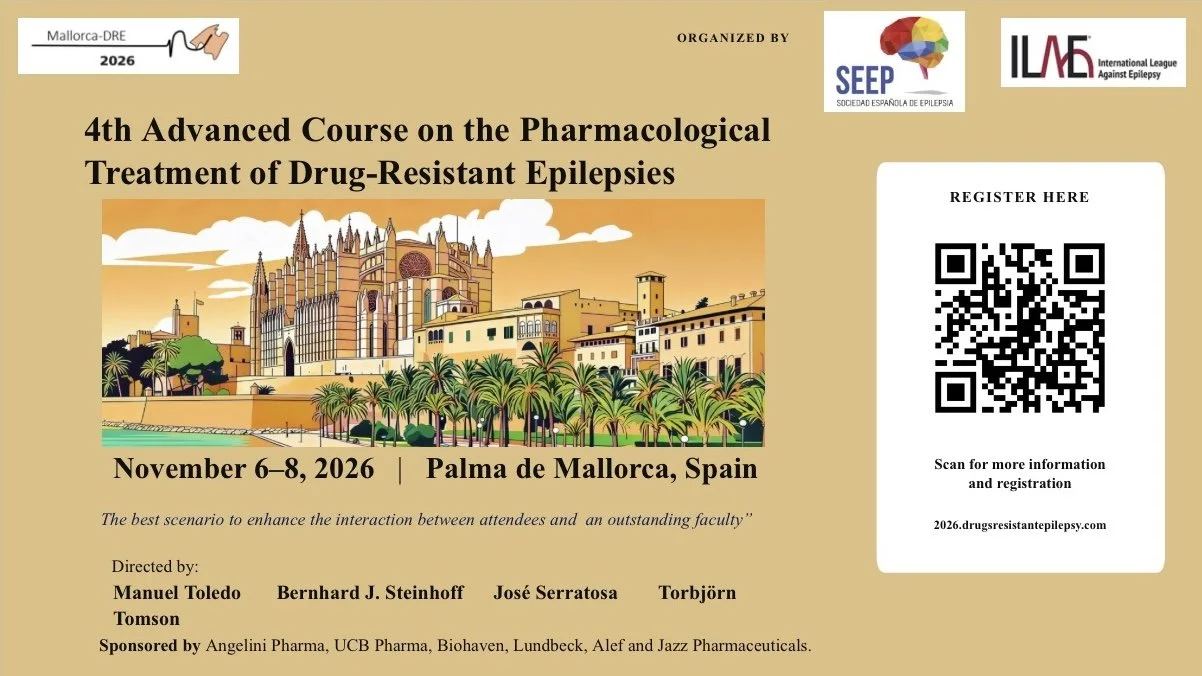
This episode is sponsored by the Drug-Resistant Epilepsy Course organised by the Spanish Epilepsy Society - supporting education and public understanding of epilepsy. Learn more about the course here: 2026.drugsresistantepilepsy.com
Episode Highlights
Effective epilepsy care means avoiding both overtreatment and therapeutic nihilism
It’s crucial to address epilepsy risks, from bathing and driving to SUDEP and unrecognised seizures.
Advances in epilepsy surgery and personalised medicine could transform treatment
About Bernhard
Prof. Dr. Bernhard J. Steinhoff has served as the Medical Director of the Kork Epilepsy Center for 26 years. His main interests are clinical epileptology and neurophysiology. He is a Professor of neurology and clinical neurophysiology at the University of Freiburg, has treated thousands of people with an epilepsy, and published numerous scientific papers. Bernhard has held several board positions at the ILAE, the German Neurological Society, the German Epilepsy Society and most recently at the European Academy of Neurology.
Full profile: Bernhard-Steinhoff
Topics mentioned
treatment strategy
safety
medication
-
Trailer
00:00 Bernhard Steinhoff
“But of course, coming back to your question, there are some aspects you have to talk about. My favourite aspect is not necessarily swimming, but the bathtub - because that is a regular risk, a life-threatening risk of epilepsy patients. Nobody speaks about that. They're all speaking about helicopter flying and… I don't know…
00:23 Torie Robinson
Hahaha!
00:24 Bernhard Steinhoff
But the bathtub is what I hate. So I'm usually not very restrictive, but in this aspect, I'm completely restrictive and I tell the patients “Don't do that.”. And, I just, basically… and of course, driving (if it's necessary), I have to tell people that they are not allowed to drive - because of the community of course. It’s not only the risk of the driver, it's the risk of the community.
Intro
00:50 Torie Robinson
What does excellent epilepsy care really look like? Is it simply about stopping seizures? Or should we be aiming for something much bigger? And then what happens when treatment itself becomes part of the problem? Today, we're joined by neurologist and epileptologist Professor Bernhard Steinhoff, Medical Director of the Kork Epilepsy Centre in Germany, to talk about personalised treatment, the dangers of overtreatment, and why nobody should simply have to put up with ongoing seizures or unpleasant side effects of medications! We’re also going to hear about exciting advances in epilepsy surgery & precision medicine that could transform care in the years ahead!
This episode is sponsored by the Drug-Resistant Epilepsy Course organised by the Spanish Epilepsy Society - supporting education and public understanding of epilepsy.
Meet Bernhard
01:34 Bernhard Steinhoff
Hi Torie, it's a pleasure to be with you today. My name is Bernhard Steinhoff. I'm a German Epileptologist and Neurologist. I'm the Medical Director of the Kork Epilepsy Center, which is a tertiary referral centre in the country in the very southwest of Germany, close to France, close to Switzerland. And I have the honour to be the Medical Director for 25 years now. So apparently I like the job.
What is great epilepsy care?
02:04 Torie Robinson
I know you see, basically, all side of the epilepsies. We're not just talking about seizures; we're talking about morbidities, whether they be psychiatric, whether they be physical, whether it's genetic, whether it's down to traumatic brain injury, whatever it might be. But looking at all of that, what do you classify as being good or great or excellent epilepsy care?
02:24 Bernhard Steinhoff
Excellent epilepsy care is if we succeed in getting patients seizure free continuously without any side effects of the treatment we're doing. And that is always what we attempt to achieve. And I usually… if you were my patient, I would tell you "Look, the only difference between the two of us, I don't have epilepsy... should be that you take one or two pills every day, and that should be the only difference between the two of us.".
02:56 Torie Robinson
Love it. It's an individual, a person who deserves to enjoy their lives.
03:01 Bernhard Steinhoff
Yeah. Absolutely. Or they don't enjoy their lives, but they should have the chance to have a normal life without any impact of the disease and the medication.
03:11 Torie Robinson
And do you look at all beyond seizures as well? Or do you pass that sort of responsibility on to say a psychiatrist or a movement disorder person?
Using the right medications
03:20 Bernhard Steinhoff
Yeah, of course. Well, to address comorbidities is always extremely important because it's not only psychiatry comorbidities. There may be a lot of other comorbidities we have to think about, especially if we look for the ideal antiseizure medication for that individual person. And I'll give you an example. For example, if I…yesterday I saw a patient with a severe neuropathic pain…
03.49 Torie Robinson
Okay.
03:49 Bernhard Steinhoff
…and epilepsy. And of course, I don't want to advertise any drugs today, but of course, pregabalin is a drug that helps against seizures and against neuropathic pain. So, instead of giving 2 or 3 complementary drugs, we give 1 drug that helps against the seizures and against the pain. Or, if you have somebody with a depression as a comorbidity, then, of course it's a good idea to consider an antiseizure medication with at least some anti-depressive action and that would be the ideal drug for that given patient.
04:29 Torie Robinson
And I suppose also you could discard the idea of some drugs as well, because some drugs are associated with, for instance, worsening mental health or making somebody extremely tired (depending upon dosage). And so it can go the other way too.
04:40 Bernhard Steinhoff
Yeah, sure, of course. And that is crucial that we speak about these possibilities with the patients and the family (in some cases) prior to this drug treatment so that they are prepared, which could happen if it doesn't work or if there are any adverse events or adverse effects. And they have to be prepared that things like that could happen. Then, of course, the second very, very important part is pharmacokinetics because, for example, take levetiracetam. We all know that's a great drug, but we all know that some patients who take it may be irritated or depressed, but you know that within a very short period of time. So you don't have to wait for 1 year or so. If somebody doesn't tolerate leviteracetam or Piracetam , you know it within 2 weeks, 3 weeks, and then you can consider an alternative because it's not the ideal drug for that patient. And on the other hand, of course we have drugs that need a couple of time, a couple of weeks, sometimes months until we have a maintenance dose and therefore you got to be patient. Both have to be patient, the physician and the patient.
05:57 Torie Robinson
And that can be very difficult. I can say, as a person with epilepsy, it can be difficult, not just because of the seizures, but also… I'm thinking… sometimes there can be side effects in the beginning and then they can kind of dissipate after time when you get used to the drug.
06:10 Bernhard Steinhoff
Yeah, that's true. That is the argument we used 25 years ago when we had only 5 drugs(!) because we didn't have alternatives. Nowadays, I'm pretty aggressive with that. If somebody is not tolerating a drug, we have so many other possibilities that I usually tell the patient “Well you do not have to suffer, even not from initial side effects.”. Usually, I'm the person who is going for alternatives. Pretty quickly then.
Capacity of neurolgoists
06:39 Torie Robinson
And I suppose that tells us that also you have to have appointments quite close together in the beginning after diagnosis or when you're still seeking to get seizure control.
06:49 Bernhard Steinhoff
Torie, that would be ideal, but I cannot offer that. What I can offer is because we have a waiting list and everything…
06:56 Torie Robinson
Mmm.
06:56 Bernhard Steinhoff
…and we see patients from all over the country, sometimes it's really a burden for me because I'm travelling 500 kilometres and I know that the level of expectation is like that and of course I'm not a miracle man. But anyway, I see those patients, for example, tomorrow I see a couple of new patients. I know that I need at least 1 hour for each patient. But then everything has to be clear for those patients. And after that, we very often communicate by email. My staff hates it.
07:31 Torie Robinson
Haha!
07:31 Bernhard Steinhoff
But yeah, I think it's the only way to perform! For example, yesterday I got 82 emails and of course I have to respond to them and that's a lot of work, but that's the only way for me to communicate appropriately.
07:47 Torie Robinson
Okay, so you're talking about emailing with the patients as well…
07:50 Bernhard Steinhoff
Yeah, yeah, sure.
07:50 Robinson
…as yeah, otherwise you just could not. Yeah, they just wouldn't be the time, the energy, yeah, the money possibly funding as well to see them face to face.
08:00 Bernhard Steinhoff
Well, in Germany you don't get any funding for that. No, no way. Even for video conferences; our video outpatient talks are not reimbursed in the country. Which is a nightmare because, well, you know, a lot of patients are not allowed to drive. Then they have to travel 300 kilometres to see me and in very, very many instances it would be possible (because I know the cases, I know the patients) to do it like we are communicating right now. But since that is not reimbursed, my financial people here in the epilepsy centre don't like it too much. I wouldn't care to be honest, but you know, I'm old and ugly enough to suffer that, haha.
08:50 Torie Robinson
Experienced Bernard, think we'll say, haha! So, traditionally, it's just drugs, drugs, drugs, right, when you're treating epilepsy, but tell us how there can be other things, like, for instance, modifying one's lifestyle. I know it's a common term, oh “lifestyle”, but it's really applicable when it comes to epilepsy. So what are changes that people can make sometimes? Do you go into that?
Sleep, alcohol, driving, and bathing
09:11 Bernhard Steinhoff
Yes, I do. But usually, if I see adolescents or young people, my favourite strategy is to treat them appropriately so that they can live a normal life, as I said before. And I don't, I personally don't like too much to tell the patients “Look, you're not allowed to do this, you're not allowed to do that.”. And that has had a severe impact on their quality of life, of course. And, well, if somebody had the experience that after massive sleep deprivation or alcohol excess, or whatever, they had seizures, well, some learn, some don't learn. And I have… in the whole literature, you don't see what is the day with the most frequent epileptic seizures worldwide. That is the 1st of January.
10:07 Torie Robinson
Of course!
10:08 Bernhard Steinhoff
Yeah, because of New Year's Eve and then my patients are happy and it's New Year's Eve, they're celebrating, they have alcohol and they miss their drugs. And next day on the 1st of January, I get 6 or 7 emails and it's always the same persons. That's what I meant. And okay, I can give them advice, but whether they follow their advice or not, well, it's their full responsibility. But of course, coming back to your question; there are some aspects you have to talk about. My favourite aspect is not necessarily swimming, but the bathtub, because that is a regular risk, a life-threatening risk of epilepsy patients. Nobody speaks about that. They're all speaking about helicopter flying and… I don't know…
11:03 Torie Robinson
Hahaha!
11:03 Bernhard Steinhoff
But the bathtub is what I hate. So, I'm usually not very restrictive, but in this aspect, I'm completely restrictive and I tell the patients “Don't do that.”. And, I just, basically… and of course, driving if it's necessary, I have to tell people that they are not allowed to drive - because of the community of course. It’s only the risk of the driver, it's the risk of the community. And then you have to be…
11:31 Torie Robinson
Yeah, no, thank you for saying that. I, yes, often when I speak to clinicians, they'll say, you know, it's not safe for you. But like you say, it's the risk of everybody else out there. What you said about the bath, bathtub, it really brought a memory back to me. So I haven't had a bath for like years for that reason. But there was one time…
11:50 Bernhard Steinhoff
Mm-mm.
11:50 Torie Robinson
…(and this is before my surgery. So like years ago, probably in about two thousand and… I don't know, 2009 or something). Anyway, so was having a shower and I was getting in and I was thinking “God, no…” and I should have got out straight away, but I find it really hard to do something when I'm in the focal. It's just so hard. And then I woke up on the floor, naked, blood all around me, because I'd had a nosebleed. And it just shows, you know, we can minimise our risk, but sometimes things are going to happen anyway. Obviously I didn't die...
12:23 Bernhard Steinhoff
Yeah, well, I can tell you I'm doing epilepsy treatment for almost 40 years now. And I lost 3 patients during my whole career in the bathtub. And speaking about that, I see the faces of these 3 persons right in front of me because you don't forget these cases.
Talking about SUDEP
12:44 Torie Robinson
Yeah and also people, remember, I think we need to remember that there are others that care about us as well, they don't want us to die, pop our clogs. And SUDEP, do you talk about SUDEP as well with patients and families?
12:55 Bernhard Steinhoff
Yes, I do. Of course I do. And I well, we learned about SUDEP, right, recently, and we are speaking about SUDEP much more. And it is clear that I would not speak about… O personally would not speak about SUDEP in every new case I see, because that is very dependent on the type of epilepsy; I can imagine who is at risk and who is not at risk. And then of course there are patients with nocturnal seizures, living alone and tonic-clonic seizures, and these are the risky persons, of course, and of course we tell them. But interestingly enough, we see a lot of inpatients as well, and most of them are seen by me as outpatients later. And during their inpatient time, we always speak about SUDEP. And then when they come back to me, I usually ask them “Well, did you ever hear about SUDEP?” and more than 50% tell me “No, I never heard of it”. So, some epilepsy patients either have a psychological neglect or they have memory problems. And therefore, it's sometimes quite good to repeat information so that the patients get the clue how to behave.
14:15 Torie Robinson
I completely agree with that. I think… I don't know about you, but I often hear of people saying “Well, I was never told about this or that.”, or “I didn't know.”. And certainly that could be the case, but we have this tendency, as you said, to have cognitive issues and maybe we just forgot. And it's… yeah. But I guess you can tell from somebody's file whether you told them all of this as well. So you can remind them.
14:39 Bernhard Steinhoff
Yes, absolutely. Of course, SUDEP is a difficult topic, but it's an important topic and patients have to be aware of the risk. As I said, we'll, of course, we have some reasonable variables nowadays and some other ideas to help the patients. You were asking about living conditions: so, if somebody is at university and not at home anymore, I love [it] if they live together with some other people in their apartment, not necessarily alone. And, of course, well, the burden of epilepsy is that you get traumatising seizures and events occasionally.
15:28 Torie Robinson
Well, fingers crossed “occasionally”, fingers crossed.
15:30 Bernhard Steinhoff
Occasionally. But you have to behave appropriately, continuously. And that is the big dilemma in epilepsy.
When people don’t know they’ve seized
15:40 Torie Robinson
Very much so. You make me think of this chap I knew and he had borderline status epilepticus, but thank goodness not. And it was a focal, but it was extended seizure and he didn't even know it had happened.
15:52 Bernhard Steinhoff
Mm.
15:52 Torie Robinson
It had gone on for ages. He was not with it for a while afterwards, he just had no idea. And I wonder if for many people, because we often don't remember seizures, we might underestimate our risk and that might make us take things not quite as seriously as we should. What do you think?
16:11 Bernhard Steinhoff
There are several publications about that. If you look at the seizure calendar and you measure, for example, with intercranial long-term EEG, what's going on, and then you see this discrepancy between the seizure calendar of the patient and the reality. Quite often, we have more seizures than the patients’ realised. I decades ago had a patient - she's still my patient actually! - and she was seizure free. Coming to me, seizure free, everything fine, and then she married, and her husband phoned me and said “Look, she's doing funny things at night.”...
17:00 Torie Robinson
Ahh.
17:00 Bernhard Steinhoff
… but she was not aware of that. And then we got her here in the video EEG, she 10 or 15 seizures every night. Wasn't aware of that. And only the marriage made possible….
17:12 Torie Robinson
Haha.
17:12 Bernhard Steinhoff
…that this seizure-free patient all of a sudden got (sic) a patient with a very active and difficult to treat epilepsy. Nowadays she's seizure free.
17:23 Torie Robinson
Oh, fantastic.
17:25 Bernhard Steinhoff
But that is a quite dramatic example of what we were talking about. But, reality, I feel, is one point and the reality in fact is another side of the metal.
When you find out you don’t have an epilepsy
17:41 Torie Robinson
And it could go the other way too, can't it? So lots of us think we're seizing and da da da, and actually it's not, it's something else like a non-epileptic seizure or it's anxiety, it's hard to tell.
17:50 Bernhard Steinhoff
Yeah. Exactly, exactly. Today I was going on rounds and I saw a couple of patients and we found out that the seizures are not seizures, are not psychogenic seizures in those cases, but misbehaving or whatever. And then if you tell the patients these are not epileptic seizures, funny enough, some of them are really angry. Yeah.
18:14 Torie Robinson
I can imagine, mmm.
18:15 Bernhard Steinhoff
Yeah. And this is something I will never understand, but anyway, I'm learning.
16:22 Torie Robinson
I reckon, sometimes, people can become a bit defined by their diagnosis and if you take that away from them. (well that's what it feels like) it can be… no one likes to be contradicted I suppose… there's that as well…
I know you've done a study on nihilism, in - should I say nihilism/nihilism; I don't know - when it comes to epilepsy and the…
18:41 Bernhard Steinhoff
Mmm.
18:41 Torie Robinson
…therapies of epilepsy tell us about that and for people who aren't familiar what does the term mean?
Therapeutic nihilism
18:46 Bernhard Steinhoff
Well, the term for me means therapeutic nihilism is a patient comes in, has epilepsy, has seizures and nothing happens. That is therapeutic nihilism. And there are several reasons for that. One reason might be that this is very difficult to treat epilepsy and then the patient or the relatives or the physician are afraid of any more side effects if they change the medication. Another point might be (and that is very often the case in my country), the regular number of outpatients a general neurologist in private practice sees in Germany per day is around 60. And if 2 of those 60 suffer from a difficult to treat epilepsy, their therapeutic nihilism is just a result of this time pressure you have. And, if then the patient comes in and says “Well, it's fine, I still have some seizures, but I'm okay.”, then the result will be therapeutic nihilism. But you should modify their treatment because the patient still has seizures. And that is very, very apparent. That's why I call it therapeutic nihilism on both sides: on the side of the patient and the side of the physician. And the other one, and I mentioned that in this article as well, is of course overtreatment. If you have difficulty to treat patients and you add number 3, number 4, number 5, anti-seizure medications, then that's just toxic.
20:19 Torie Robinson
Often, yeah.
20:20 Bernhard Steinhoff
Toxic and not helpful, and therefore you need always a strategy how to overcome that. And if you, for example, you introduce a very powerful drug like cenobamate. Cenobamate is a drug with a lot of enzyme-inducing potential, it's not a perfect drug for combination therapy, but it's only licensed for combination therapy in Europe. So if you install cenobamate you have to think about how to deal with the other drugs. Recently, we published that as well in the European Journal of Neurology, and it's very apparent the easier, the simpler the therapy strategy (for example, with cenobamate) is, the better are the patients. And you have to achieve that.
21:05 Torie Robinson
And you can often kill two birds with one stone, I think we sort of mentioned this earlier, right. So if you, like, for instance, just for example, lamotrigine, right, that can…
21:13 Bernhard Steinhoff
Yeah.
21:13 Torie Robinson
…sometimes help with mood and seizures, or it can be the reverse. You mentioned levetiracetam or keppra; if you adjust that, then that can also improve the mood, which is often a real problem for many people. So it's looking at the whole picture, isn't it.
Strategy: new medications and side effects
21:27 Bernhard Steinhoff
Absolutely. And it breaks down to an individual physician-patient relationship. Because some patients are unfair enough not to have the side effects you would foresee. I know patients who are fantastic with leveteracetam and didn't…
21:45 Torie Robinson
Yes! Right?
21:45 Bernhard Steinhoff
…tolerate lamotrigine. And… okay. And then you have to realise that this is reality in this individual case and believe what the patient is telling you.
21:59 Torie Robinson
Would you say that the fair amount of the time people don't believe what the patient or the carer says?
22:03 Bernhard Steinhoff
I wouldn't say so. Most physicians really try to listen to the patient and to help those patients, but it is always difficult to be 100% convinced that certain things will happen in medicine. For example, I was talking about enzyme-inducing drugs; it's not only cenobamate, it's carbamazepine, it's a lot of other enzyme-inducing drugs. But you have the enzyme-inducing properties not in every patient. So here we have a huge variation between patients. And these rules are not 100% rules. They are just estimations. And of course, we have literature addressing that. But nothing is 100% in medicine or in biology.
22:55 Torie Robinson
It's so true. I see lots of people online who've heard that a particular drug has awful side effects and they'll just say “I don't want to take it.” because they’re assuming that will happen. And I think that's a real missed opportunity. I can say personally, I've been on, when I've looked up my drugs on Medscape, it’ll say “Clash, clash, clash”, but they don't clash for me.
23:15 Bernhard Steinhoff
Mm.
23:15 Torie Robinson
So it’s that a great example? So I think we need to, like you say, look at the individual and figure out what's right for them.
23:22 Bernhard Steinhoff
Yeah, and always very, very helpful is always to have a strategy, as I said. So, if I see a patient, have a plan A, but I always tell about the plan B if plan A is not working, so that the patient gets a perspective that if my advice is not working, this is not the end of the story. We have alternatives and we will go for that. And that's very helpful in my experience for the patients and their trust, and self-esteem, and everything.
23:58 Torie Robinson
And hope and realistic hope. Like, if this doesn't work then…
24:01 Bernhard Steinhoff
Of course.
Epilepsy surgery
24:02 Torie Robinson
And, so what do you reckon the next 5 -10 years holds for the epilepsies globally?
24:09 Bernhard Steinhoff
Very good question. I think we didn't speak about epilepsy surgery today.
24:15 Torie Robinson
No, not.
24:15 Bernhard Steinhoff
Epilepsy surgery… it essential to look for the possibility of epilepsy surgery. Well, 20 minutes ago, I saw a patient and we are discussing the possibility of epilepsy surgery for 5 or 6 years now, but she's so afraid about the potential consequences that I still didn't convince her. But, still, we have a lot of possibilities with antiseizure medications. We have epilepsy surgery, we have new surgical techniques that make it easier, especially for elderly patients.
24:54 Torie Robinson
Oh, do tell, how does that work for, and why is it different for elderly patients?
24:58 Bernhard Steinhoff
I was thinking about the LIT therapy, laser thermocoagulation and in temporal lobe epilepsy and these patients, if they're appropriate patients, who do not have a receptive epilepsy surgery, but you just implant one electrode (under MRI investigation), and then you do this laser therapy - well, you melt the tissue, more or less (but under MRI) and next day patients can go home. Because it's much less invasive and especially for elderly patients or for defensive patients, it is a nice alternative. Interestingly, in Germany, not every insurance is covering that, haha.
25:51 Torie Robinson
Hmm.
25:52 Bernhard Steinhoff
But, we are working on that. But that's just an example. And of course, we have new neurostimulation techniques that are applied in some of our patients.
Precision medicine for children and in DEEs
26:03 Bernhard Steinhoff
And, I think if you're asking about the next 5 to 10 years, you know, I'm an adult neurologist, but the music's played in neuropaediatrics right now because of personalised medicine. You find new mutations responsible for DEEs and we are just on the way to find personalised medicine. A lot of substances are developed right now so that we do not treat only the seizures, we treat the whole disease.
26:39 Torie Robinson
The cause as well, like sorting that out.
26:41 Bernhard Steinhoff
Yeah, the cause as well. And we have one example that is in tuberous sclerosis where we have everolimus for a couple of years now. And it was nicely shown that that helps against the seizures, but also against the underlying tumours. And that is an example for personalised medicine. And we will have a lot more examples for that in the next 5 to 10 years, but in neuropaediatrics. So the other neurologists, if it works, won't see those patients anymore because they are cured.
27:15 Torie Robinson
Don't worry, we're all getting older, so I'm sure there are going to be…
27:17 Bernhard Steinhoff
Haha!
Increasing number of older people with an epilepsy: the future
27:15 Torie Robinson
…lots of adult patients anyway. That's another point, isn't it? Over the next few years, there are going to be more adult patients, people who develop epilepsy at an older age.
27:27 Bernhard Steinhoff
Of course, of course, people are getting older and the older you get, the higher is your chance, although your risk to get an epilepsy due to vascular diseases, after stroke… we have those stroke units, which is wonderful, of course. Patients don't die due to strokes anymore, but as a result of stroke, of course, you can develop epilepsy. We have the big topic of dementia, of Alzheimer's, and other dementia diseases, along with seizures. And that is a completely new perspective we have right now. I think, at least in my country, probably in the UK as well, we certainly do not have the structure to deal with that accordingly.
28:18 Torie Robinson
So, hopefully over the next 5 to 10 years, everyone should listen to this and hopefully sort that out. We need more funding from the governments, the insurers need to cover it, because it's not going to go away.
28:28 Bernhard Steinhoff
It's a nightmare, you know. Elderly people in residential homes. And that is not, I do not want to offend any colleagues or whatever, but we do not have to structure to look at those people accordingly, appropriately. Absolutely not. And everybody tells you, the literature tells you that the elderly patients who develop epilepsy at old ages are easier to be treated. I think that is not true. That is just a statistical artifact. And I know a lot of elderly people who have difficult to treat epilepsy. And also the impact on the relatives is enormous, enormous. Makes a big difference whether your partner had epilepsy forever or whether your partner develops epilepsy at age 75, and your partner is the driver and everything, and the female partner. I just think about it. To pay one patient and his wife, I have in my outpatient clinic. And that's a nightmare. They're living in the black forest. He's not allowed to drive anymore. And his wife is extremely frightened that other seizures might occur. That is a very difficult, difficult topic.
29:51 Torie Robinson
I can imagine the loneliness, the mental health… It’s so important that you mentioned the people around them who don't have epilepsy. The impact can be huge.
29:59 Bernhard Steinhoff
Absolutely, absolutely.
Hope: never give up
30:01 Torie Robinson
All right. Well, thank you very much for your insights and sharing just a slither of your experience, Bernhard. Well, there's hope for the future. So... and let's bring more hope, I think, to the adults, the adult population with epilepsy too.
30:15 Bernhard Steinhoff
Well, we're working on that every day. Never give up. We have new chances. We get new antiseizure medications and we should avoid overtreatment. We should avoid therapeutic nihilism. And if you don't have the right answer, just well, ask me and I do my very best.
Closing thoughts & thanks
30:33 Torie Robinson
A huge thank you to Bernhard for sharing his extraordinary experience and such an encouraging message! What really stands out is that excellent epilepsy care isn't about prescribing more and more medication. It is about finding the right treatment for the right person, listening to their experiences, and never giving up when something isn't working!
Thank you to the Drug-Resistant Epilepsy Course organised by the Spanish Epilepsy Society - for sponsoring this episode and supporting education and public understanding of the epilepsies. See you next time!